

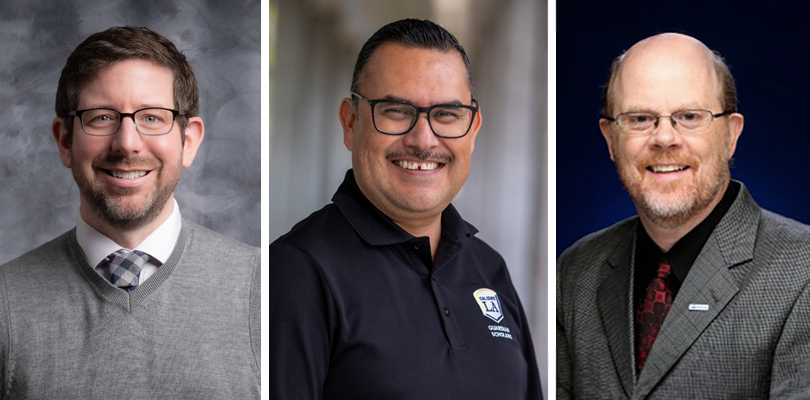
One in a series of features we are planning to highlight the different groups of public servants who benefit from their membership in CalPERS.
Gregorio Alcantar is a first-generation college graduate raised by immigrant parents who supported four children while working blue collar jobs.
Ken Shultz is the youngest of four siblings and the first in his family to attend college after high school.
Aaron Moore credits a full-ride college scholarship with helping shape his future and the career he now enjoys in the CSU Office of the Chancellor.
These three changemakers now work for an educational system that equips millions with keys to a better future. They and their fellow California State University (CSU) employees represent 12% of CalPERS’ total membership.
We spoke with them about their career paths and eventual retirement with the security of a CalPERS pension.
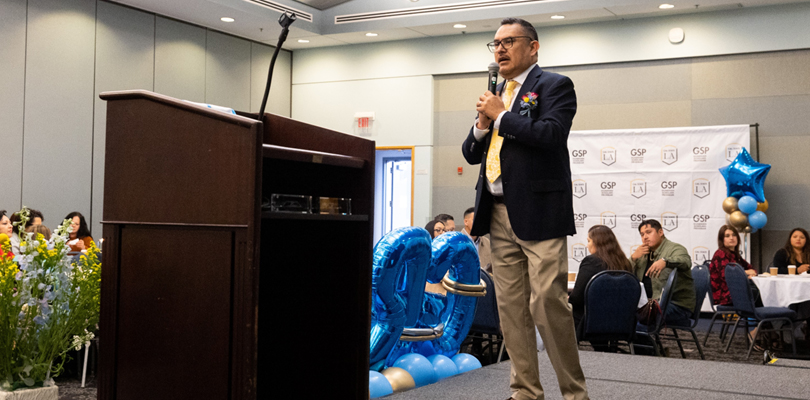
Gregorio Alcantar, Cal State L.A.
Gregorio Alcantar knows what it means to pursue higher education without a roadmap.
“As a low-income family in the San Fernando Valley, my dad worked in a factory, and my mom was a housekeeper at a hospital, cleaning bathrooms and sweeping the cottages where resident doctors from UCLA were housed,” he said. “The only thing my parents were sure of was that I had to get a college education to have a better life full of opportunities.”
Support came from unexpected places. A middle school teacher helped ensure Alcantar finished his schooling and completed his college application, while a UCLA recruiter helped him see his own potential.
“I was ranked eighth in my graduating class, out of more than 500 seniors,” he said. “I remember the UCLA recruiter, Maria Wilcox, asking me, ‘Do you know what college is? And do you know what UCLA is?’ My answer to both questions was no — I truly did not know. I thought I’d be going to work with my dad at the factory. Maria said, ‘Well, you will be going to UCLA, and I’ll help you apply.’”
Alcantar earned his undergraduate degree from UCLA and later received a master’s in counseling from CSU Northridge. He became a college counselor in 2005 and now helps students who have experienced foster care navigate life and learning at Cal State L.A. through its Guardian Scholars Program.
“Many of these students are first-generation college students themselves, and so I feel that I have come full circle,” Alcantar said. “Just as others helped me get through college, I do the same now.”
Alcantar dedicated himself to helping students be their best and fall in love with learning.
“Education is truly the ultimate equalizer. It helps you see that the world is bigger than what you know,” he said. “At the time, I thought the town I grew up in was my whole world. But I later realized there was so much more out there — and I loved it. That is what I want other students to see.”
Alcantar, meanwhile, appreciates the resources and education that CalPERS provides in the lead-up to his eventual retirement. He is also already thinking about how his pension will enable him to volunteer, consult, and pursue his passion for music when he retires. “Just being able to kind of wake up late and not have to be on a clock,” he said. “That’s something to look forward to and work toward.”
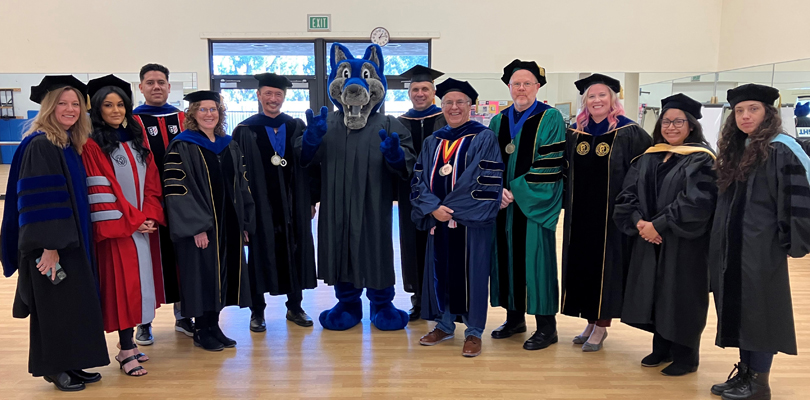
Ken Shultz, CSU San Bernardino
Being the first in his blue-collar family to graduate from college was a milestone for Ken Shultz (pictured above, fourth on the right). Earning a master’s degree and PhD after that felt almost unimaginable — not just for him, but for his extended family as well.
“And then to spend 34 years as a psychology professor at Cal State San Bernardino — it’s well beyond what I could have ever imagined growing up in Syracuse, New York,” he said.
Today, Shultz teaches two psychology graduate classes and is in the faculty early retirement program. Previously he served as department chair, where he led 25 full-time and 25 part-time faculty members in a department serving 100 graduate students and 1,600 undergraduates.
“A lot of our students are working in the warehouses right now,” he said. “I think it’s a good motivator for them. They say, ‘I can’t do this for 20 or 30 years as a job.’ Education is their way out.”
Now nearing full retirement, Shultz has thoughtfully planned for the next chapter.
“CalPERS is going to allow my wife and I to do what we want to do in our retirement,” he said. He looks forward to traveling, supporting his children, and embracing a new sense of freedom. “My CalPERS pension is going to more than meet our needs.”
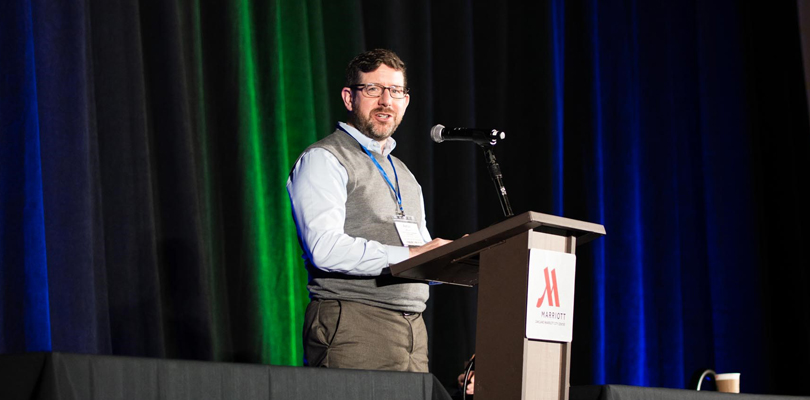
Aaron Moore, CSU Office of the Chancellor
Growing up in the Central Valley, Aaron Moore’s parents attended college while working to support him and his two sisters. So, when he learned he’d received a full-ride scholarship to attend CSU Long Beach, he and his parents breathed a collective sigh of relief.
“It’s not easy for any family to put three kids through college,” Moore said. “Fortunately, the Cal State system provided a high quality, affordable education to all three of us.
“Along with my family’s contribution to my education and living expenses during college, the scholarship allowed me to graduate debt free.”
Going into the workforce without looming student loans gave Moore more freedom after graduation. He later earned a master’s degree in public administration, which was half funded through a scholarship.
Today he works in the CSU Office of the Chancellor as executive director of advancement. He is also chief financial officer for the CSU Foundation, where he manages its finances, board relations, and engagement with more than 4.5 million alumni.
Moore sees his role as helping to position California as a leader in the education space and beyond, saying, “It is the largest system of four-year public education in the country. I think the CSU is really an unsung hero that underpins California’s economy and culture.”
Moore called his CalPERS benefits “foundational to my current and future security.”
“It allows me to not have to invest mental energy into knowing that some of those ‘basics,’ are going to be there for me in retirement.”
Are you a CalPERS member with a story to share? We’d love to hear from you for consideration in a future PERSpective article. Take our brief survey.