

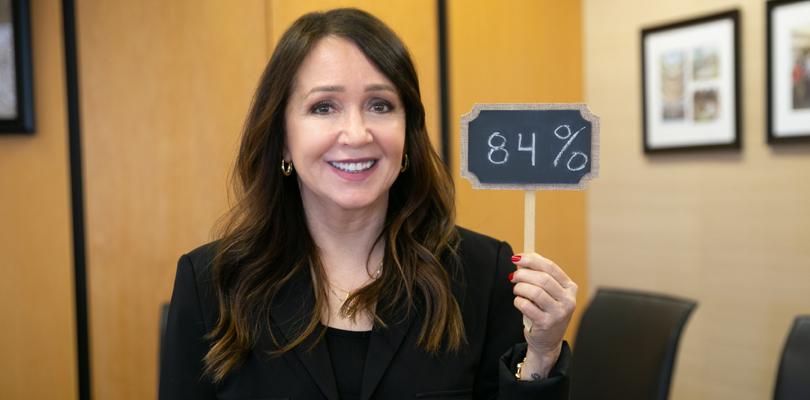
When Marcie Frost arrived at CalPERS in 2016 as its new CEO, she knew her new job represented a big opportunity — and a big challenge.
She had built a 30-year career in Washington state, where she had risen from clerk/typist to executive director of the state pension system and a member of the governor’s cabinet.
Frost said she was drawn to CalPERS, the nation’s largest public pension fund, by the fact that it was just 65% funded — about 20 percentage points lower than Washington.
“Everyone watched CalPERS, and I just felt the experience I had in Washington could be really helpful,” she said in a recent interview.
In her early years on the job, Frost said, “I used to get a lot of letters from members expressing concern: ‘Is my benefit really safe? Is my benefit going to be there when I need it five years down the road or 10 years down the road?’”
Frost gets far fewer worried letters these days. As of Dec. 31, 2025, CalPERS’ assets totaled 83.7% of what is needed to pay benefits to all present and future retirees. U.S. public pension systems, on average, have a funded ratio of 75% to 80%.
“When I look back at what I’m proud of, it’s the funded level improvement,” Frost said. “That’s something everyone in the CalPERS system should be proud of.”
A singular focus
Frost said she and the other members of the leadership team at CalPERS remain singularly focused on the goal of achieving 100% funding. She talks about this topic so often that a colleague jokingly gave her a paddle she can raise in meetings to display the current funded status — reminding attendees that every decision will be evaluated against whether it improves that number.
Under Frost, CalPERS has diversified and refined its investment strategy. The organization has also held its own budget steady and has not grown its workforce. Member calls are answered in an average of three minutes and 45 seconds.
“We have looked at every decision in our budget cycle to say, ‘Does this improve the funded levels? Does this improve the members’ experience? Does this make us a more reliable partner?’” Frost said.
She said she has devoted her life to protecting the pensions of public servants because of lessons she learned growing up in the rainy timber town of Forks, Washington.
‘I really saw them suffer’
Frost spent her summers living with her grandparents and was close to them. Her grandfather, a decorated World War II veteran, worked as a timber feller. She said her grandparents saved carefully for retirement, only to see their savings wiped out by one catastrophic family event. Frost said their home fell into disrepair and they struggled to pay their utility bills while living on Social Security.
“I really saw them suffer,” she said.
Frost said she’s proud that California has protected its defined benefit pension plan, which provides guaranteed payments for life. She noted that employee contributions and investment earnings fund about two-thirds of the pension system, with about a third coming from state and local employers. The average CalPERS retiree receives a monthly pension of $3,772, or $45,264 a year.
“I’m obviously not going to get the opportunity to meet every single one of our 2.4 million members, but they drive every single decision I make at CalPERS,” Frost said. “I think of them as my grandparents. I think of them as my parents.”