


These are among CalPERS CEO Marcie Frost’s top achievements in her 10th year of leading the largest defined-benefit public pension in the nation.
Speaking at the July CalPERS Board of Administration meeting, Frost outlined these developments and stressed the importance of continually improving the health of the fund while tuning out external noise that could jeopardize that effort.
“I want to thank the board and our remarkable team members for the focus, passion, and discipline that you’ve all brought to your work over the past 10 years,” Frost said. “We’ve helped maintain our focus on better serving our 2.4 million members in every facet of our business, from investments, to health, to customer service outreach.”
Rebuilding CalPERS’ funded status
When Frost began her CalPERS tenure in October 2016, the pension system’s funded status — at 68% — hadn’t recovered from the Great Recession.
“Back then I received emails, and not only emails, but actual correspondence from our members,” Frost said. “They were worried whether their pension would actually be there when they needed it, and they were worried whether their pension would be there throughout their lifetime.
“I’m happy to report today that those emails and that correspondence have largely disappeared. And our funding level at the end of fiscal year 2025-26 is 85% — and that is up from 79% at the end of fiscal year 2024-25.”
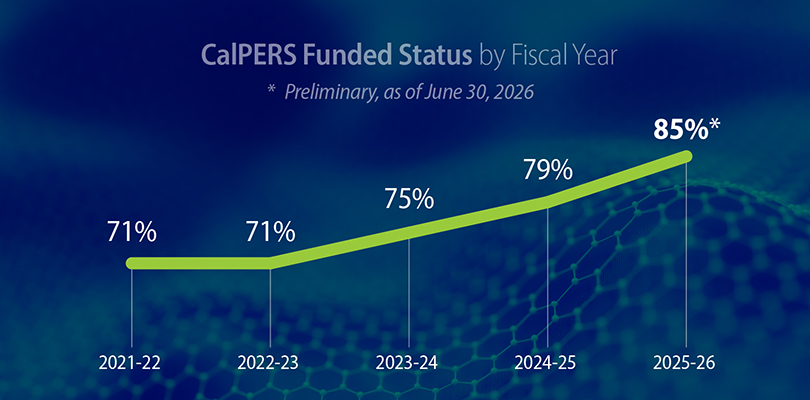
The fund is healthier today, Frost said, because of “strong investment returns and the discipline we imposed on the system.”
Hard decisions to fulfill pension promise
This discipline included adopting a new actuarial amortization policy, moving from a 30-year schedule to a 20-year policy in 2018. In simple terms, that means contracted employers would aim to pay off any unfunded pension liabilities over 20 years instead of 30.
CalPERS also lowered the discount rate — the assumed rate of investment return that helps determine how much money is needed today to pay future benefits — several times, from 7.5% to 6.8%, where it stands today.
“These were hard decisions because they meant that employers and members would pay more into the retirement and would not be receiving additional benefits for those increased costs,” Frost said. “But they were necessary decisions to support the pensions rightfully promised to public employees for their years of service.”
Building a portfolio to exceed expectations
While CalPERS adjusted its discount rate and adopted a new amortization schedule to protect and grow the fund, “We set out to build an investment portfolio that would exceed those expectations,” Frost said.
Building such a diverse, resilient portfolio has also required discipline, she noted. The CalPERS board has resisted pressure to pull out of certain stocks or asset classes because of factors unrelated to performance.
The result:
- In fiscal year (FY) 2025-26, CalPERS earned a preliminary return rate of 14.8%.
- That’s up from the already strong 11.6% in FY 2024-25, and 9.3% in FY 2023-24.
- It’s CalPERS’ best return since 2014, apart from 2021 when the market was rebounding from the pandemic.
CalPERS’ public equity and private equity investments fueled these recent returns.
The global equity portfolio remains the largest single fund category, and the strong return of our broad stock holdings “once again illustrates the importance of maximizing the return for our members by not foregoing investments in strong performing companies because of external pressures,” Frost said.
Private equity was a strong second performance-wise this year, with Anton Orlich and his team making CalPERS a leader among institutional investors with a strategy that emphasizes greater investment in venture and growth.
“The up-and-coming managers of these funds are producing better returns and truly driving the growth of innovation and job creation in California, the nation, and the world,” Frost said. “Investing in the private market gives us the potential to earn higher returns while spreading our risk from the often-volatile public stock market.”
‘Building the health of the fund remains job No. 1’
CalPERS’ current 85% funding level is great compared to the 68% level in 2016, “but we’re not there yet — it’s not full funding,” Frost said.
“Building the health of the fund remains job No. 1,” she said. “We have to maintain our singular focus on the great fiduciary responsibility we have to our 2.4 million members.
“We cannot afford to become complacent or assume that the market will always keep rising just because it did yesterday or the day before, or the month before that.”
Healthcare and customer service shine
The CalPERS Health Program, led by Don Moulds, is leading the way in healthcare by bringing market and member data to the table in their contract negotiations with health plans.
“In a world where healthcare costs keep rising, they are keeping increases as minimal as possible,” Frost said. She noted that CalPERS health plan premiums will rise less than 5% on average in 2027 and the average Medicare premium will remain flat. This compares to 9% inflation in the healthcare market generally.
On the customer service front, the CalPERS Contact Center has cut call wait times by 38% this year since Customer Services & Support Deputy Executive Officer Kim Malm hired Thor Dunn from the California Department of Tax and Fee Administration to lead the division. The Contact Center recently had its first “perfect day” where every call received was answered and successfully handled.
“Success like this doesn’t just happen,” Frost said. “It’s a result of hiring the right people, developing them well, and planning their schedules in an optimal way to respond to our members when they need us.”